Unusual Options Activity (UOA)

Automated detection of significant options trades

Unusual Options Activity Detection

Optionomics monitors options flow in real-time and flags trades that stand out from normal activity. Large trades, aggressive orders, and unusual volume patterns often signal that something interesting is happening—whether it’s institutions positioning, informed trading, or major hedging.

Availability: Gamma plan and higher ($59/month+)
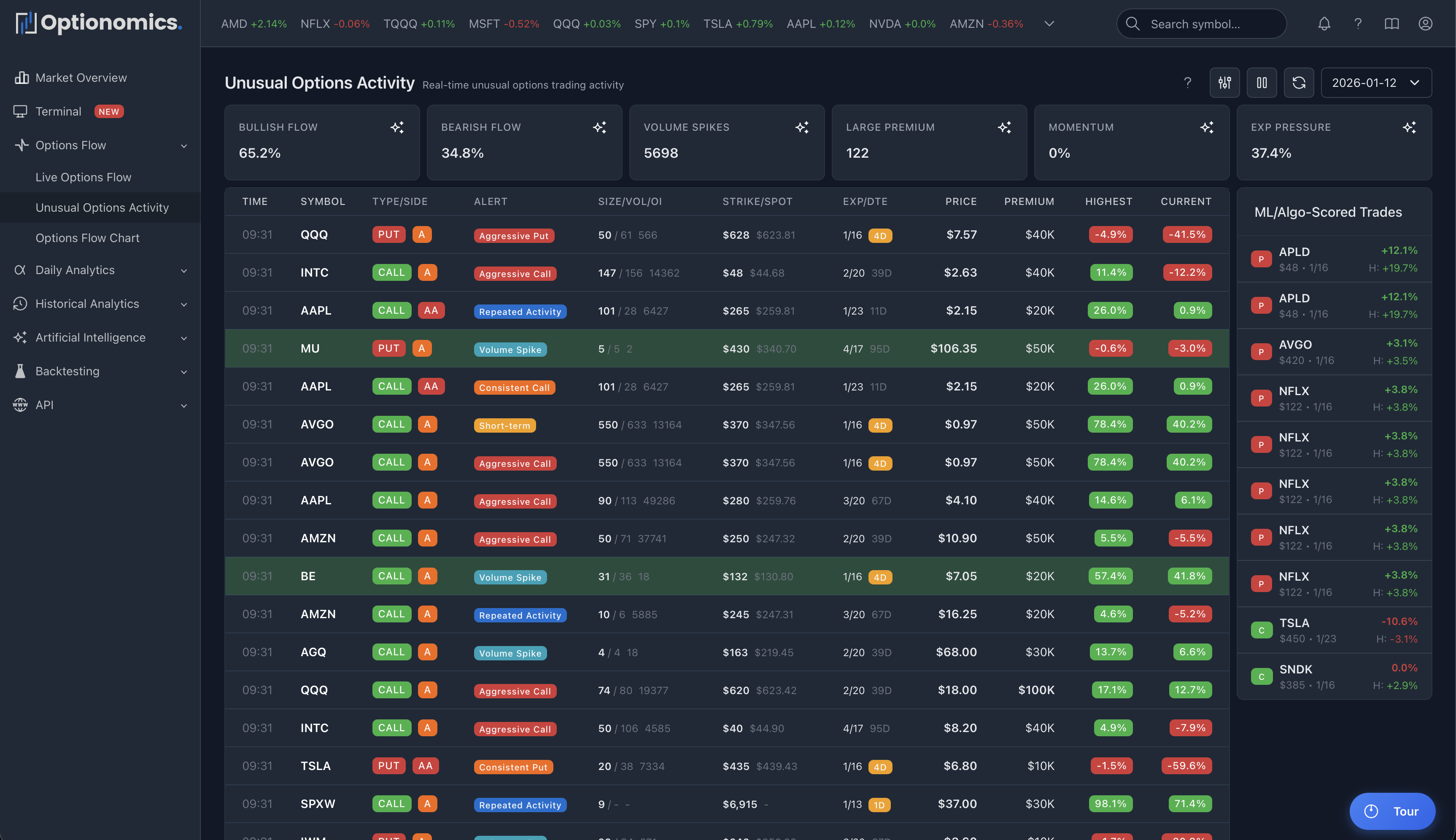
What is Unusual Activity?

Not every big trade is unusual. We look for patterns that deviate from normal trading behavior:

  • Size: Trades much larger than typical for that strike/expiration
  • Aggression: Buyers paying above ask or sellers hitting below bid
  • Volume: Trading volume exceeding open interest
  • Patterns: Repeated activity in the same contract
  • Timing: Large trades in short-dated options

The system analyzes every trade during market hours and assigns an unusual score (0-100) based on multiple criteria. Higher scores mean more unusual.

10 Detection Patterns

The system looks for these specific patterns:

1. Aggressive Call Buying

Someone is paying above ask for calls—they want in now instead of waiting for a better price. This shows strong bullish urgency.

2. Aggressive Put Buying

Same as above but for puts. Paying above ask for puts signals bearish urgency or portfolio protection.

3. Consistent Call Buying

Not one big trade, but repeated buying showing accumulation over a short time window. Institutions often buy this way to avoid moving the market with one massive order.

4. Consistent Put Buying

Same accumulation pattern but for puts. Could be building protection or a large bearish position.

5. Large Call Purchase

A single massive call trade with significant premium. These get flagged when the dollar amount is substantial enough to indicate institutional activity.

6. Whale Trade

The biggest of the big—extremely large trades by premium or contract size. These are institutional-size trades that can move markets.

7. Repeated Activity

Rapid-fire trading in the same contract within minutes. Could be algorithmic trading, urgency, or a large order being executed in pieces.

8. Short-Term Options Activity

Significant trades in options expiring soon. Short-dated options are for imminent moves—big trades here suggest something is expected quickly.

9. Volume Spike

When a trade represents a significant portion of the contract’s open interest. This indicates notable new positioning rather than existing positions changing hands.

10. Volatility Spike

Implied volatility jumping significantly over a short time period. Sudden IV expansion often precedes news or indicates informed buying.

How Scoring Works

Each detected pattern gets a base unusual score (0-100), with more significant patterns receiving higher scores. Additional factors can increase the score:

Score Boosters:

  • Sweep orders (aggressive multi-exchange execution)
  • ISO/Intermarket sweeps
  • Block trades (large institutional prints)
  • Exceptionally large premium or contract size

The final score caps at 100. Generally:

  • 90-100: Critical—the biggest, most unusual trades
  • 75-89: High priority
  • 60-74: Moderate
  • Below 60: Low priority

You can filter by score to focus on what matters most to your strategy.

What Shows Up as Unusual

Sweep Orders: When someone aggressively buys or sells across multiple exchanges at once, taking out all available liquidity at each price level. They’re paying above ask (for buys) or accepting below bid (for sells) to get filled immediately rather than waiting for a better price.

Why this matters: Sweeps indicate urgency. The trader could save money by being patient, but they’re choosing speed over price. This often happens when someone has information or strong conviction and wants in (or out) NOW. Sweep orders frequently precede significant price moves.

Block Trades: Single massive prints, usually negotiated off-exchange. You’ll see one huge order fill all at once rather than being broken up into smaller pieces.

Why this matters: Block trades are almost always institutional—hedge funds, banks, market makers. However, they might be hedging existing stock positions rather than making pure directional bets. A big put block might be a bearish bet, or it could be someone protecting a large stock holding.

Opening New Positions: When the volume of trades exceeds the existing open interest, it means new positions are being opened (not just existing contracts trading hands). This represents fresh capital entering that specific strike and expiration.

Why this matters: New money coming in is more significant than existing positions being shuffled around. It indicates conviction—someone is initiating a new trade. When you see volume significantly higher than open interest, pay attention.

Multi-Leg Strategies: The system attempts to identify spreads and complex strategies like verticals, calendars, iron condors, and butterflies by looking for simultaneous trades in related strikes or expirations.

Why this matters: Multi-leg strategies typically indicate more sophisticated traders who are thinking in terms of risk/reward profiles rather than simple directional bets. These traders are often managing risk more carefully and have specific profit targets in mind.

How to Use UOA

In the Flow Scanner

Set your filters to show only unusual trades:

  • Filter by unusual score (e.g., 75+)
  • Filter by premium ($100K+, $500K+)
  • Filter by specific stocks or sectors
  • Filter by DTE for event-driven trades

Custom Alerts

Create alerts for specific unusual activity patterns. For example:

  • “Alert me when SPY has whale trades (score 90+)”
  • “Alert me for any unusual calls on AAPL with 7 DTE or less”
  • “Show me aggressive put buying over $200K premium”

Dashboard View

The UOA dashboard shows:

  • Today’s most unusual trades
  • Total premium in unusual activity
  • Bullish vs bearish distribution
  • Most active symbols

Important Things to Remember

Not All Unusual Activity is Actionable: Just because a trade is flagged as unusual doesn’t mean you should immediately copy it. A big trade might be:

  • A hedge against an existing stock position: Someone who owns 100,000 shares might buy protective puts. That’s bearish positioning in options, but they’re actually long the stock.

  • Closing an existing options position: What looks like aggressive selling might actually be someone closing a profitable trade, not initiating a new bearish position.

  • Part of a complex spread you’re not seeing: You see a big call buy, but you’re not seeing the call sell at a higher strike. It might be a bull call spread with limited upside.

  • Tax-related positioning: Near year-end, you’ll see unusual activity that’s driven by tax considerations rather than market views.

Context Matters: Unusual activity is more meaningful when you understand the context:

  • What’s happening in the news: Check if there’s been news, earnings announcements, FDA decisions, or other catalysts. Unusual activity ahead of news often indicates informed positioning.

  • Where the stock is trading technically: Unusual call buying at major resistance is different than unusual call buying after a breakout. Price action context matters.

  • Whether earnings or events are coming up: Large trades in short-dated options ahead of earnings could indicate someone expects a move. Or it could be someone selling premium expecting a non-event.

  • The broader market environment: Unusual put buying during a market crash might just be panic. The same activity during a rally is more notable.

Risk Management: Even if you follow unusual activity, manage your risk appropriately:

  • Size your positions: Don’t bet the farm just because you saw a whale trade. Use position sizing that matches your risk tolerance.

  • Use stops: Options can move against you quickly. Know your exit point before you enter.

  • Remember time decay: Options lose value every day, especially as expiration approaches. If you buy options, you need the stock to move relatively quickly.

  • Options can go to zero: Unlike stocks, options can expire worthless. Only risk capital you can afford to lose entirely.

Best Practices

  1. Use UOA as one piece of your analysis, not the only piece
  2. Look for multiple confirming signals (technical, news, other flow)
  3. Be especially attentive to repeated patterns in the same stock
  4. Track what happens after unusual activity you notice—learn the patterns
  5. Don’t chase. If you missed it, there will be another one

Subscription Access

  • Gamma Plan ($59/month): Full unusual activity scanner and alerts
  • Theta Plan ($79/month): Everything in Gamma + AI to explain what you’re seeing
  • Vega Plan ($99/month): Everything + API access to unusual activity data

Remember: Unusual activity is interesting and often meaningful, but it’s not a crystal ball. Large traders can be wrong too. Use it as intelligence, not as trade signals. Do your own analysis and manage your risk.


Getting Started
Options Basics
Platform Features
Daily Analytics
Historical Analytics
Account Management